
Obituaries

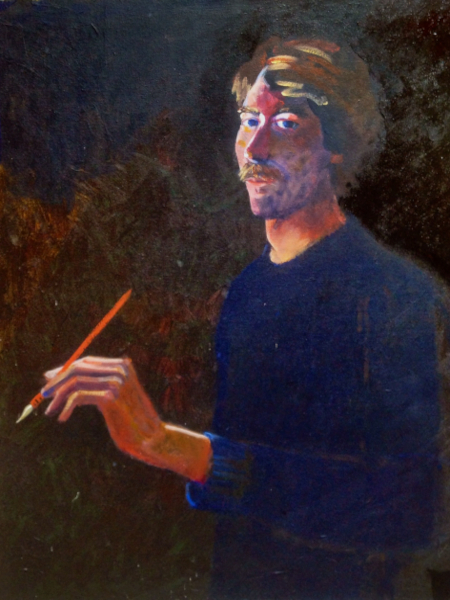
David W. Richardson
February 25, 1947 - August 22, 2024
Life Legacy
David Wesley Richardson
February 25, 1947 - August 22, 2024
David Wesley Richardson of El Sobrante, CA, a brilliant and prolific California landscape artist died unexpectedly at the age of 77 on August 22.
While recognized for his landscape painting, David was also an accomplished sculptor, portraitist, caricaturist, book illustrator, sign painter, published author, poet, teacher, writer, historian and raconteur. Over the years, he lived and worked in many places including Porterville, Delano, Springville, the Monterey Peninsula, San Francisco, Southern California, Montreux, Switzerland; Formentera, Spain and Soumensac, France.
For three of those years starting in 1973, David resided at the Goodman Building, a communal living space of artists’ residences and studios located on the corner of Van Ness and Geary in San Francisco where it sat, as described by David, “like a disintegrating sugar cube.”
In doing the research for “An Ethnography of the Goodman Building: The Longest Rent Strike,” the author Niccolo Caldararo asked David to share notes on life in the Goodman Building as he experienced it.
“There were splendid moments…There were long nights spent laughing on the roof of the building as the comet Kohoutek streaked the sky and the universe smiled. I lost all sense of time painting the canvasses hung on my perfect studio walls. My eyes retained the colors and images of what I was painting. I grew used to seeing my hand, the studio, the checkerboard of the hotel across Geary, the world as if made of paint. Art was everywhere…The artists and residents were collective and singular, solo acts and members of a chorus, we were the children in the Labyrinth if not paradise, we were saltimbanques and street rebels. We achieved notoriety if not complete acceptance. We were not radical, ours was an old fight, we were certainly never chic. Others joined the original residents. Others brought others, we all learned to dance on the ancient threadbare tightrope between artistic expression and human survival, and to one degree or another, by one definition or another, by choice or not, all shotgun wed to political action.”
In 1990, driven by an insatiable appetite that knew no bounds to see and make art, David traveled to join friends in Soumensac, located in the southwest region of France. His horizons expanded at every turn as he took his inspiration from the breathtaking views the area offered him. He returned on numerous occasions in the years that followed. Along with being remembered for his warmth and wit by those who hosted and embraced him on those stays, he produced some of his most beautiful work while there. Much of that remains behind in homes and on gallery walls in the region.
David’s art has been celebrated, exhibited and collected by many. In 1970, at the age of 23, his work was presented at The Green Room, Tantamount Theater, Carmel Valley, CA. In the 54 years that followed he showed at, among other galleries and museums, San Francisco Museum of Modern Art, Oakland Museum, Galerie Lychnitis, Paros, Greece; Lawson Gallery, San Francisco; Laguna Beach Museum of Art, Linn-Benton Community College, Albany, OR; Galerie Cinciano, Cinciano Val d’Elsa, Italy; Architects and Heroes, San Francisco; College of the Sequoias, Visalia, CA; Galerie Rondré, Soumensac, France; Bakersfield Museum of Art, and Carl Cherry Center for the Arts, Carmel, CA.
It was at the Cherry Center that David’s book, “Resemblance: Portraits of Characters from Marcel Proust’s In Search of Lost Time” had its California showing. The work is made up of 78 portraits, painted in acrylic on 4 x 3 ½ inches of balsa, framed in one piece for an exhibition that ran January 13 - February 17, 2017. David had often said it took him three years to finish reading Proust’s work, and another three years to paint the 78 pieces. As he stated in “Notes on the Portraits” introducing the work, “Proust’s words guided my brush. His genius invited me to explore pathways of my own. Painting Marcel’s characters allowed me to remain in his world while traveling mine, opened new trails from an unforeseen moment into adventure through and beyond the Meseglise and Guermantes way, and caused my time to be happily lost and found.”
Regardless of where he lived and where his painting took him he was always, to his core, the proud descendant of settlers who first arrived in the Central Valley in the latter part of the 19th century, making him a 5th generation Californian on his maternal side, a 4th generation Californian on his paternal side.
David’s maternal great grandfather, David Newton Snider was born in1866 in San Luis Obispo. He married Victoria Buenaventura Gil, born in 1870 in the José Mario Gil Adobe located on Fort Hunter Liggett near Jolon in the southwestern part of Monterey County. The site, established in 1865 by Don José Maria Gil, a prosperous Monterey rancher of Spanish origin, was officially listed on the National Register of Historic Places on June 7, 1974. David’s grandfather, Wesley William Snider, was born in 1896 in Pattiway, Kern County. He served in the US Department of Agriculture Forest Service, working in the Sequoia - Tule River district. He planted and cared for the redwoods and vistas David cherished. The love of that topography was etched on David’s genes.
David’s mother Barbara Jean Snider married Kenneth Harry Richardson in November, 1945. His father’s middle name was a tribute to his great grandfather, Harry Quinn, born on Christmas Day 1843 in Kilkeel, County Down, Northern Ireland. Harry emigrated to Australia in 1859 and then to America in 1863. Having started work as a sheep handler at the age of eight, he ultimately became a prosperous sheep rancher with land holdings that at one point totaled over 22,000 acres in Rag Gulch. In 1909, Harry sold a block of holdings of Quinn Ranch to the Richgrove Land Company for the establishment of the town of Richgrove.
Born in Porterville, David first picked up a brush at the age of seven and was painting to the day he died. He graduated from Delano High School, continuing his painting studies with Margaret Wheeler and John Cunningham, as well as attending classes at Art Center College of Design and California College of the Arts.
In Springville, David became active in the local art scene. A member of the Foothill Art Association and the Friends of the Tule River, David captured the beauty of the Southern Sierra mountains and the foothills he loved. His artwork hangs in the lodge of the Clemmie Gill School of Science and Conservation, SCICON, the outdoor environmental school operated by the Tulare County Office of Education.
David was preceded in death by his parents, Kenneth Richardson and Barbara Snider Richardson; his sister, Elizabeth Victoria Richardson and Bonnie the dog. He is survived by his sister, Sarah Richardson Schafer; his brother-in-law, Harry Schafer; extended family members and a loving circle of lifelong friends.
David will be laid to rest alongside his family in Springville, CA. Plans for a celebration of David’s life are pending. In lieu of flowers, the family has requested that you please consider making a donation in David’s memory to the California State Summer School for the Arts Foundation (CSSSA Foundation) or an art school of your choice.
Of his return to Springville in 1995, after having left the area for some time he said:
“The images and ideas are astonishing - there’s a painting everywhere I look…”
Thank you, David, for sharing your irrepressible joie de vivre, your boundless imagination and your dazzling talent. You've enriched our lives and will be missed beyond measure.
Arrangements have been entrusted to Grissom’s Cremation & Burial Centers.
Contact Us
Grissom's Chapel & Mortuary Inc.
267 E. Lewelling Blvd.
San Lorenzo, CA 94580
Directions
(510) 278-2800
Grissom's Cremation & Burial Centers
9130-B Alcosta Blvd.
San Ramon, CA 94583
Directions
(925) 560-0800
Grissom's Crematory, Inc.
267 E. Lewelling Blvd.
San Lorenzo, CA 94580